Salary calculator
Germany 2026 Gross to net in English
Estimate your take-home pay, see where the deductions go and compare what two job offers leave you after monthly costs.
Regular employment with statutory insurance. See supported cases

Compare two job offers after costs
See what each offer leaves you after rent, utilities and other monthly spending.

Try a worked comparison
Load two sample offers and their costs. Your main calculator inputs stay as entered.
See the example amounts and assumptions
These buttons replace both saved offers and their costs. They use the same illustrative payroll profile for both jobs: tax class I, ZKF 0, statutory health insurance with a 2.9% supplement, one relevant child for care insurance, no childless surcharge and employment outside Saxony. No church tax or bonuses. Your main calculator inputs stay unchanged.
| Example | Annual gross A → B | Monthly net A → B | Rent + utilities A → B | Other costs, each | Remaining A → B |
|---|---|---|---|---|---|
| 1: More left | €48,000 → €60,000 | €2,622.17 → €3,149.92 | €1,000 → €1,300 | €500 | €1,122.17 → €1,349.92 |
| 2: Less left | €60,000 → €72,000 | €3,149.92 → €3,663.37 | €1,000 → €1,700 | €500 | €1,649.92 → €1,463.37 |
Example 1 adds €527.75 net pay but €300 in housing costs: €227.75 more remains. Example 2 adds €513.45 net pay but €700 in housing costs: €186.55 less remains. Replace the costs with your own figures; missing expenses still need to be budgeted.
How to compare your own offers
- Save offer ACalculate the first offer and save its payroll assumptions.
- Save offer BChange the calculator for the second offer and save it separately.
- Enter monthly costsCompare what remains and download the result.
Enter or change salary and payroll details ↑
Editing the calculator leaves saved offers intact. Save an offer again to replace it. The comparison clears when you reload or leave this page.
Offer A
No scenario saved yet.
Include commuting, food and other planned spending. Zero is a placeholder, not a cost estimate. Avoid counting a cost twice.
Offer B
No scenario saved yet.
Include commuting, food and other planned spending. Zero is a placeholder, not a cost estimate. Avoid counting a cost twice.
Your monthly comparison
| Monthly amount | Offer A | Offer B |
|---|
Remaining budget is net pay minus only the costs you entered. It excludes unentered spending and is not a recommendation to accept a job. Working hours, benefits, moving costs and job security also matter.
Uses the salary calculator’s supported 2026 scope: regular German employment with statutory insurance. No church tax, bonuses, private insurance or class-IV factor method. The download contains your saved figures and assumptions; review it before sharing.
Share the comparison tool
The link opens the tool, not your results. It contains no salary, family details or spending amounts.
Gross-to-net salary examples for Germany in 2026
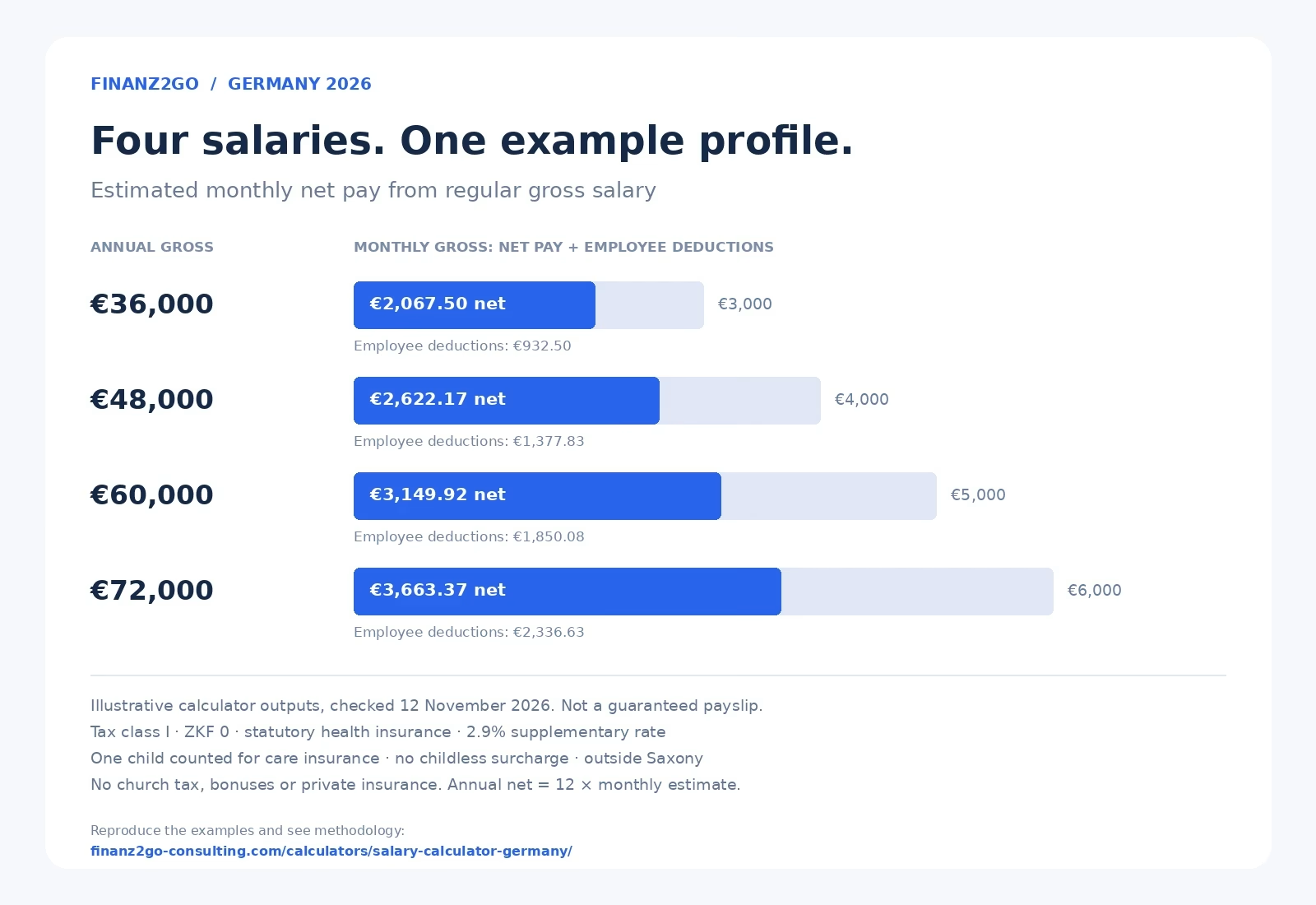
Compare four gross salaries under the same payroll assumptions. Load any example to see how its deductions are calculated.
See the assumptions and exact amounts
Four illustrative salaries, one fixed profile: tax class I, ZKF 0, statutory insurance with a 2.9% supplementary health rate, one child counted for care insurance, no childless surcharge and employment outside Saxony. No church tax, bonuses or private insurance. These are outputs of this calculator, not typical salaries or guaranteed payslips.
| Annual gross | Monthly gross | Monthly deductions | Estimated monthly net |
|---|---|---|---|
| €36,000 | €3,000.00 | €932.50 | €2,067.50 |
| €48,000 | €4,000.00 | €1,377.83 | €2,622.17 |
| €60,000 | €5,000.00 | €1,850.08 | €3,149.92 |
| €72,000 | €6,000.00 | €2,336.63 | €3,663.37 |
Use a “Load” button to load that salary and the complete profile into the calculator. This replaces your current calculator entries; saved job-offer scenarios remain available. Adjust the fields to your payroll records before relying on a result. Monthly deductions combine wage tax, solidarity surcharge and employee social contributions. The annual net display is twelve times the monthly estimate.
For this profile, moving from €48,000 to €60,000 annual gross adds €527.75 to estimated monthly net pay. Use the job-offer comparison to subtract your own rent and other costs, or check the cost-of-living guide before building a budget.
Frequently asked questions
Are my entries sent to Finanz2Go?
No. The calculation runs in your browser and the form does not submit your salary, tax-class or family-related entries to Finanz2Go.
Does this show my employer’s total payroll cost?
No. It shows the employee deductions in the supported case, not employer contributions or total employment cost.
Can this calculator estimate my tax refund?
No. Monthly wage-tax withholding is not an annual tax return or tax assessment.
What should I do if I do not know my Pflegeversicherung status?
Check your payslip and ask your payroll team or insurer. Keep “I’m not sure” selected until the childless-surcharge status and children counted for contribution reductions are confirmed.
Can I use the result in a salary discussion?
You can compare supported inputs, but the result is not a guaranteed payslip amount. Explain the assumptions and leave room for payroll facts the calculator does not cover.
Help with your estimate
What the calculator covers
Scope check
Before you start
This calculator estimates take-home pay for one regular employment in Germany in 2026. You can enter monthly gross pay from €2,000.01 to €999,999.99, or annual gross pay from €24,000.12 to €11,999,999.88.
- It covers statutory pension, unemployment, health and long-term-care insurance.
- It does not cover bonuses, one-off payments, mini- or midijobs, private health insurance, multiple jobs or partial months. No church tax is included.
- If you enter annual pay, we use a rounded monthly amount for the estimate. Any small difference is shown with your result.
Your entries stay in your browser.
Scenario estimate only: not a payslip, tax return, forecast or personal tax/payroll advice.
Know the limits
Why your payslip may look different
This calculator gives a simplified estimate for one regular employment in 2026. Your actual payroll can include facts the form does not collect.
- No church tax or class-IV factor procedure.
- No private health insurance, private care insurance or related employer subsidies.
- No bonuses, severance, company cars, benefits in kind or other one-off pay.
- No mini- or midijobs, multiple jobs, partial months, mid-year starts or exits, short-time work or pension payments.
- No individual payroll allowances, foreign tax, cross-border payroll, self-employment or annual tax assessment.
- Employer-specific payroll treatment and information not entered here can also change the amount.
Use the result as an estimate
It is not a guaranteed net salary, payslip, tax return or individual tax, legal or payroll advice. The supported range starts at €2,000.01 monthly gross and ends at €999,999.99 monthly gross.
Where to find each payroll input
Your inputs, explained
Find each answer before you calculate
Use your employment contract, payslip and insurer information. These links take you to a short explanation of every field already in the calculator.
Gross salary: start with your pay before deductions
Gross salary is your pay before wage tax and employee social contributions are taken out. Use the regular cash salary in your employment contract or payslip and choose whether your amount is per year or per month.
Do not add bonuses, one-off payments, a company car or benefits in kind. They are outside this calculator.
Go to gross salary ↑Tax class: use the one on your payslip
Your Steuerklasse is the tax class your employer uses for wage-tax withholding. It changes the amount withheld each month, but it does not by itself determine your final annual income tax.
Use class I, II, III, IV, V or VI exactly as shown on your payslip or payroll record. The class-IV factor method is not supported.
Go to tax class ↑Child allowance: a tax entry, not your number of children
ZKF is the number of child allowances recorded for payroll tax. It may include a half allowance such as 0.5. Find it on your payroll tax record or ask payroll if it is not shown clearly.
ZKF is not Kindergeld and it is separate from the child information used for long-term-care insurance. Enter 0 for tax classes V and VI.
Go to child allowance ↑Health insurance: find your fund’s additional rate
Statutory health funds charge an insurer-specific additional contribution called Zusatzbeitrag. Enter the full percentage published by your fund—not only the employee half.
Check your fund’s website or contribution notice. The prefilled 2.9% is the official average for 2026; your fund’s rate may be different.
Go to health rate ↑Long-term care insurance: why your family details matter
Pflegeversicherung is Germany’s long-term-care insurance. The calculator asks two separate questions because the childless surcharge and the multi-child reductions follow different rules.
For the surcharge, choose Yes only if payroll applies it. For reductions, enter the number of children your payroll or insurer counts for that purpose. Age, parent status and legal exceptions can matter, so use “I’m not sure” until the information is confirmed.
Go to care-insurance fields ↑Working in Saxony
Saxony uses a different split of the basic long-term-care contribution between employee and employer. That is why the calculator asks about the employment location used for payroll.
Select Saxony only when that payroll employment location is in Saxony. Your home address alone does not answer the question.
Go to Saxony field ↑How to read your deductions
Understand your result
Where your gross salary goes
The result shows what remains and which employee deductions reduce regular gross pay.
Take-home pay
The amount left after the wage tax, solidarity surcharge and employee social contributions shown in the result.
Wage tax
Lohnsteuer is income tax withheld through payroll. It is a monthly deduction, not a final annual tax assessment.
Solidarity surcharge
An additional tax linked to wage tax. Depending on the calculated wage tax, the result may be zero.
Pension insurance
Your employee contribution to Germany’s statutory pension insurance.
Unemployment insurance
Your employee contribution to statutory unemployment insurance.
Health insurance
Your employee share of statutory health insurance, including the fund-specific additional rate you entered.
Long-term care insurance
Your employee contribution to Pflegeversicherung, adjusted for the supported family and Saxony settings.
Annual values are twelve times the monthly estimate
The calculator models one monthly payroll period. Every annual result is twelve times that monthly value; it is not an annual payroll calculation or tax return.
A practical example
An example: from annual salary to monthly take-home pay
This example shows how the calculator’s existing fields work together. The assumptions are listed beside the result.
- Annual gross
- €60,000.00
- Monthly gross
- €5,000.00
- Tax class
- I
- Tax child allowance
- 0
- Health supplementary rate
- 2.9%
- Childless surcharge
- No
- Children counted for care insurance
- 1
- Employment location in Saxony
- No
From €5,000.00 monthly gross, this example subtracts €792.58 wage tax, €0.00 solidarity surcharge, €465.00 pension insurance, €65.00 unemployment insurance, €437.50 health insurance and €90.00 long-term care insurance.
The annual net display is €37,799.04—twelve times the monthly estimate. A real payslip can differ if your situation includes facts outside the stated limits.
Official sources and methodology
Official sources
Sources for the 2026 assumptions
Use these primary sources to check the tax program, contribution rates, ceilings and long-term-care rules behind the estimate.
Editorial responsibility: Fabian Beining, founder and operator of Finanz2Go. Read our editorial policy for sourcing and corrections. This attribution is not a claim of independent payroll certification. The examples above were reproduced on 12 November 2026; the parameter-check date below is separate.
Related guides and calculators
Share the calculator or example graphic
A reference you can share
Keep the assumptions with the numbers
These four examples use the same profile shown in the table above. They are calculator outputs, not a salary survey or personalised tax advice.
Open the full-size salary graphic · Read the accessible data table