
Searching for “IHK certificates financial advisor Germany” is a sensible first step, but the phrase can be misleading. Germany does not issue one universal “IHK-certified financial adviser” badge that authorises every kind of financial planning. An adviser may hold an IHK examination certificate, a trade-law permission under one or more sections of the German Trade Regulation Act (Gewerbeordnung or GewO), and an entry in a public register. Those are related, but they are not the same thing.
For expats, the practical task is to identify what service is being offered and then verify the corresponding legal status. Insurance intermediation is primarily addressed by §34d GewO. Advice or intermediation concerning specified financial investments within a statutory exemption is addressed by §34f GewO. Fee-only advice within that same limited investment universe has a separate status under §34h GewO. Banking, securities services outside those exemptions, tax advice, legal advice, real-estate brokerage and mortgage intermediation may fall under entirely different rules.
This guide explains what the permissions and IHK competence certificates can demonstrate, what they cannot demonstrate, and how a consumer can check an adviser before sharing personal information or signing anything. For wider planning context, read Finanz2Go’s introduction to financial consulting in Germany and its guide to choosing an expat financial advisor in Germany.
Important: This is general educational information, not legal, regulatory, tax, investment or insurance advice. Rules, competent authorities and an adviser’s status can change. Check the official register, the current legislation and the relevant authority for your case.
First: what does “IHK certificate” actually mean?
The Industrie- und Handelskammer (IHK) is the Chamber of Industry and Commerce. In this area, an IHK may administer a statutory competence examination, participate in permission or registration procedures, maintain register data through the chamber system, or act as the competent authority, depending on the permission and the German state or locality.
Consumers should distinguish at least four documents or facts:
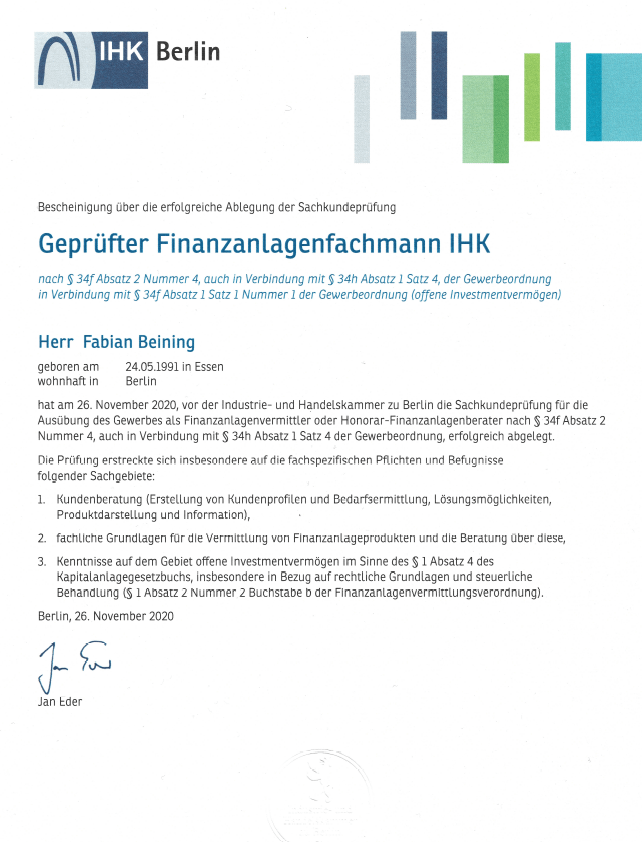
- A competence examination certificate (Sachkundenachweis) shows that a person passed a specified examination, such as the insurance intermediation examination or the financial investment specialist examination. Certain recognised qualifications can be treated as equivalent, so absence of that exact exam title does not automatically mean absence of competence.
- A trade-law permission (Erlaubnis) shows that the authority granted permission for a defined regulated commercial activity. Its scope matters. A §34f permission, for example, can cover one, two or all three statutory product categories.
- A public register entry shows the status and category recorded for the business or person at the time you search. It gives consumers a practical verification route.
- Continuing compliance means the business must still meet applicable conduct, information, documentation, insurance, registration, training or audit duties after permission is granted. The original paper certificate alone does not prove that every later duty has been met.
This is why “IHK certified” should prompt follow-up questions rather than end the enquiry. Ask for the exact legal section, status, category and registration number. A framed certificate may be genuine but irrelevant to the product being recommended.
§34d GewO: insurance intermediaries and insurance advisers
Section 34d GewO regulates commercial insurance intermediation and insurance advice. It separates several statuses that should not be casually merged.
An insurance intermediary under §34d(1) may be:
- an insurance representative (Versicherungsvertreter) acting on behalf of one or more insurers or another representative; or
- an insurance broker (Versicherungsmakler) undertaking intermediation or conclusion of insurance contracts for the client without being entrusted by an insurer or insurance representative.
An insurance adviser (Versicherungsberater) under §34d(2) has a different permission. The statutory definition requires that the adviser not receive an economic benefit from an insurer or otherwise be dependent on one. This adviser can advise the client, including specified legal advice concerning insurance contracts and claims, represent the client out of court, and arrange insurance for the client. The insurance adviser may be paid only by the client and may not accept insurer inducements connected with the advice. A business cannot simultaneously conduct the §34d(1) insurance-intermediary trade and the §34d(2) insurance-adviser trade.
There are exceptions and special routes. For example, a tied representative may not need an individual §34d(1) permission where the statutory conditions are met and the insurer assumes unrestricted liability for the intermediation activity. Product-accessory intermediaries may qualify for an exemption, while narrowly defined ancillary sellers can fall outside permission and registration requirements. The IHK Berlin overview of insurance intermediaries and advisers summarises these distinctions and warns consumers indirectly why “no personal permission certificate” is not conclusive by itself.
Permission prerequisites under §34d
For an ordinary permission under §34d(1) or §34d(2), the law requires the relevant authority to refuse the application if one of the following barriers exists:
- Reliability: facts justify the conclusion that the applicant lacks the reliability required to operate the business.
- Orderly financial circumstances: the applicant lives in disordered financial circumstances.
- Professional indemnity insurance or equivalent guarantee: the required evidence cannot be produced.
- Competence: the applicant cannot establish the necessary insurance-technical, legal and customer-advice competence through the prescribed IHK examination or an accepted alternative route.
The law gives examples for the first two tests. Certain final criminal convictions within the five years before application will generally count against reliability. Open insolvency proceedings or an entry in the relevant debtor register will generally indicate disordered financial circumstances. These are permission prerequisites, not a promise that an adviser will never make a mistake or that a recommended contract will perform well.
For some legal entities, competence can be demonstrated through an appropriate number of qualified supervisory employees who represent the applicant. That route does not apply in the same way when a natural-person applicant personally intermediates or advises, or is responsible for that activity in management. Consumers should therefore ask both who holds the permission and who will actually advise them.
Professional indemnity for §34d activities
The Insurance Intermediation Regulation (VersVermV) supplies detailed rules. The required professional indemnity must apply throughout the EU and EEA. The current text of §12 VersVermV states minimum cover of €1,276,000 per insured event and €1,919,000 for all insured events in a year, with the statutory mechanism applying updated amounts under the relevant EU technical standard. Because minimum amounts can be adjusted, consumers and applicants should check the current official rule rather than rely on an old article.
Indemnity insurance is important, but it is not a compensation fund and does not insure product performance. Coverage is designed for liability risks arising from the regulated professional activity, subject to the law and policy terms. It does not mean every client complaint will be paid.
Registration and ongoing duties under §34d
Relevant insurance intermediaries and advisers, along with responsible persons in management, must be entered in the register promptly after starting the activity; changes to stored details must also be reported promptly. Tied representatives are registered through the responsible insurer under the applicable route.
The §34d framework also imposes an annual continuing-education duty of 15 hours per calendar year on the regulated businesses and directly involved employees covered by the law, subject to statutory qualifications and exceptions. §7 VersVermV explains acceptable formats and requires supporting records to be retained for five years. Continuing education supports maintained competence; it does not independently certify the quality of each recommendation.
Insurance distribution also brings organisational and conduct duties. These include managing remuneration and conflicts, handling complaints, providing required information, and—depending on the transaction—determining the customer’s wishes and needs, advising and documenting the reasons for a recommendation under the applicable insurance-contract rules. Requirements become more detailed for insurance-based investment products.
§34f GewO: financial investment intermediaries
Section 34f GewO is separate from insurance permission. It applies to commercial investment advice or investment intermediation conducted within particular exemptions from the banking and securities-institution regimes and only for the listed categories:
- units or shares in qualifying domestic open-ended investment funds, open-ended EU funds, or qualifying foreign open-ended funds permitted for distribution under the German Capital Investment Code;
- units or shares in qualifying domestic, EU or foreign closed-ended investment funds; and
- investments (Vermögensanlagen) within §1(2) of the German Investment Products Act.
A §34f permission may be limited to one or more of those categories. A register entry for category 1 should not be presented as authorisation for categories 2 and 3. More importantly, §34f is not a blanket licence for every security, banking product, discretionary portfolio-management service or financial activity. An adviser operating under another regulatory structure—such as a tied-agent regime or a licensed institution—may have a different verification trail.
The IHK Berlin §34f page illustrates why location matters: in Berlin, the local district trade office (Ordnungsamt) grants the §34f permission, while the IHK system handles the register entry. In another state, responsibilities can differ. “IHK certificate” is therefore not always an accurate description of the permission document itself.
Permission prerequisites under §34f
The four central tests resemble §34d but must be considered separately:
- Reliability of the applicant and relevant persons managing the business or a branch;
- orderly financial circumstances of the applicant;
- professional indemnity insurance meeting the applicable standard; and
- competence in the professional and legal foundations and in customer advice, demonstrated for the requested product category or categories through the IHK examination or a recognised equivalent.
The statutory reliability test again refers to specified convictions within the preceding five years as typical evidence of unreliability. Open insolvency proceedings or an entry in the stated insolvency or enforcement registers will generally indicate disordered financial circumstances. These checks address access to the occupation. They are not a credit rating, fiduciary audit, performance record or endorsement of the adviser’s business model.
A directly involved employee must also have the required competence evidence, and the business must check that employee’s reliability. The business and directly involved people must be entered in the intermediary register, and changes must be reported promptly.
Professional indemnity under §34f
The Financial Investment Intermediation Regulation (FinVermV) sets the operational rules. §9 FinVermV currently states minimum professional-indemnity cover of €1,276,000 per insured event and €1,919,000 for all insured events in a year, irrespective of how many §34f categories the permission covers. The insurance must cover financial-loss liability risks arising from the regulated activity under the regulation, with the specified treatment of assistants and partnerships.
Again, the existence of professional indemnity is not evidence that an investment is safe. It covers qualifying professional liability, not ordinary market losses, issuer insolvency or a client’s disappointment with returns.
Ongoing §34f duties are not the same as §34d duties
Do not transfer the insurance intermediary’s 15-hour annual training rule to §34f by assumption. The important ongoing §34f/FinVermV regime instead includes status and remuneration disclosures, fair and non-misleading communications, conflict management, information on risks and costs, product information, suitability or appropriateness processes, documentation, record retention and annual compliance examination.
Under §24 FinVermV, a regulated business generally must have compliance with §§11a–23 examined for each calendar year at its own expense and submit the report by 31 December of the following year. If it conducted no relevant §34f or §34h activity in the reporting period, it must submit the prescribed negative declaration instead. There are specific provisions for certain businesses operating exclusively for a distribution company, as well as special examinations ordered for cause.
This annual examination is a compliance mechanism, not an investment-performance audit. It does not mean an authority has approved every portfolio or recommendation.
Initial information: what should you receive?
Initial disclosures are useful because they let a consumer compare what the adviser says with the public record.
For insurance under §34d
At the first business contact, §15 VersVermV requires information including the intermediary’s name and business address; exact status as broker, representative, tied representative, product-accessory intermediary or insurance adviser; whether advice is offered; the type and source of remuneration; the registration number and register contact details; certain ownership links with insurers; and the relevant dispute-resolution body.
Do not accept “independent” as a substitute for the statutory status. A broker, representative and insurance adviser have different roles and remuneration rules. Ask for the initial information document in a durable form and retain it with the recommendation.
For investments under §34f or §34h
Before the first investment advice or intermediation, §12 FinVermV requires clear, understandable information in text form, including name, business address and direct contact details; whether the person is registered under §34f or §34h and for which categories; how to verify that entry; the issuers and providers whose investments are offered; the competent permission authority; and the registration number.
Before advice or intermediation begins and before the advisory contract is concluded, remuneration information must also state whether the investor pays a fee and how it is calculated, or whether third-party inducements may be accepted or retained. Ask for actual euro amounts where they are known and the calculation method where they are not.
Remuneration: commission, client fees and conflicts
A certificate does not tell you how the adviser is paid. That question must be answered separately for each activity.
A §34d(1) insurance intermediary may receive remuneration through commission included in the premium, direct customer payment, other benefits or a combination where legally permitted; the required initial disclosure identifies the model. A §34d(2) insurance adviser, by contrast, may be remunerated only by the client and may not accept insurer benefits connected with the advice.
Under §34f, third-party inducements such as commissions may be permitted only if the required disclosure and conduct conditions are met. §17 FinVermV requires comprehensive, accurate and understandable disclosure of the existence, nature and amount—or the calculation method—before contract conclusion, and the inducement must not impair proper service in the investor’s interest. Remuneration arrangements and sales targets must not create incentives to recommend a product when another available investment would better meet the investor’s needs.
“Fee-based” in marketing is not automatically the same as the statutory Honorar-Finanzanlagenberater status under §34h. A §34f intermediary may charge a client fee in some arrangements while still holding §34f status. Verify the register category and obtain the written remuneration agreement.
The §34h distinction: fee-only investment advice in a limited field
Section 34h GewO applies to commercial investment advice within the same three product categories referenced by §34f when the adviser does not receive an inducement from a product provider or depend on it in another way. It is a distinct permission, not a premium grade added to §34f.
A §34h adviser and a §34f intermediary cannot conduct both trades simultaneously. When §34h permission is granted, the §34f permission expires. The §34h adviser must base recommendations on a sufficiently broad range of investments covered by the permission, diversified by type and provider or issuer, rather than a range limited by close commercial links.
The client must pay for the §34h advice. A third-party inducement is allowed only in the narrow case where the recommended or an equally suitable investment is not available without it; the payment must then be transferred to the client promptly and without deduction, subject to taxes and charges. The IHK Berlin §34h overview confirms the mutual exclusivity and registration route.
Even §34h remains bounded. It does not automatically authorise tax advice, legal advice, insurance advice, discretionary asset management or every security transaction. “Fee-only” also does not guarantee low total costs: assess adviser fees, product costs, custody and transaction charges together.
Suitability, appropriateness and the client information process
For investment advice, §16 FinVermV requires the adviser to obtain the information needed about the investor’s knowledge and experience, financial circumstances—including ability to bear losses—and investment objectives, including risk tolerance. Only investments suitable on that information may be recommended. If the adviser does not obtain the required information, no investment recommendation may be made within that advisory process.
For pure intermediation rather than advice, the appropriateness test focuses primarily on whether the client’s knowledge and experience allow the risks of the investment type to be understood. If the product appears inappropriate, or the necessary information is not obtained, warnings are required. The legal process and exceptions are more detailed than this summary.
Consumers should treat fact-finding as protection, not bureaucracy. An adviser who recommends immediately without understanding residence, currency, emergency reserves, time horizon, tax position, existing holdings, dependants, risk tolerance and loss capacity may be skipping information essential to a responsible recommendation. Expats should also ask explicitly about the consequences of leaving Germany and whether the adviser is qualified to address cross-border issues—or will coordinate with a tax or legal professional who is.
How consumers can verify an adviser
Use the official Vermittlerregister rather than relying on a screenshot supplied by the adviser. The register is publicly searchable and covers insurance intermediaries, insurance advisers, financial investment intermediaries, fee-only financial investment advisers and mortgage intermediaries.
A practical verification process is:
- Obtain the adviser’s full legal name, business name and registration number from the initial information document.
- Search the registration number. If necessary, use the advanced search with the legal name and location.
- Match the spelling, business address and legal status. Similar names are not enough.
- For §34f or §34h, check the registered product categories. Confirm that the proposed investment belongs to a covered category.
- For §34d, check whether the entry says broker, representative, tied representative, product-accessory intermediary or insurance adviser.
- Check who holds the permission when you are speaking with an employee or commercial agent. Ask how that individual is registered or supervised.
- Compare the competent authority shown in the disclosure with the register and, if something conflicts, contact that authority directly.
- Save a dated PDF or screenshot for your records, while recognising that status can later change.
A missing match is a reason to pause, not proof of fraud. It may result from spelling, a recent change, an employee operating under a registered principal, or a different regulatory regime. Ask for a written explanation and verify it with the relevant authority or institution before proceeding.
What IHK certificates and register entries do not guarantee
An IHK examination certificate demonstrates defined competence at a point in time. A permission indicates that legal entry requirements were met. A register entry supports public verification. None is an all-purpose quality guarantee.
They do not, by themselves, prove:
- independence from every product provider or distribution organisation;
- whole-of-market analysis;
- expertise in US tax, UK pensions, international succession or another expat-specific issue;
- authority to provide reserved tax or legal advice;
- authorisation for every investment, mortgage or insurance activity;
- low costs, good performance or capital protection;
- that the adviser has never received a complaint;
- that a product is suitable for you; or
- that professional indemnity will reimburse market losses.
Credentials should be the beginning of due diligence. Service scope, experience, conflicts, remuneration, product universe, planning method and communication quality are separate tests.
Questions to ask a financial adviser in Germany
Use these questions in an introductory meeting and request written answers where the issue matters:
- What exact permission or regulatory status covers each service you offer me?
- What is your registration number, and under which legal name should I search?
- Are you acting as a §34d insurance broker, representative or insurance adviser?
- For investments, are you registered under §34f or §34h, and which of the three categories are covered?
- Who holds the permission: you personally, your company, a principal or a licensed institution?
- Which IHK examination or recognised equivalent qualification do you hold?
- How are you paid for each product—client fee, commission, ongoing trail payment, another benefit or a combination?
- What is the amount or calculation method, and what happens to remuneration if I cancel or transfer?
- Which providers and products can you consider, and which can you not consider?
- Do you have ownership links, sales targets, preferred-provider arrangements or other conflicts?
- What information will you collect to assess suitability, needs, risk tolerance and ability to bear losses?
- What written recommendation, suitability statement, product information and cost disclosure will I receive?
- How do you support English-speaking clients, and which binding documents remain in German?
- What experience do you have with clients who may move countries?
- Where does your competence end, and when do you refer to a German tax adviser or lawyer?
- How are complaints handled, and which dispute-resolution body is available?
- How do you protect personal and health data?
- What ongoing review service is included, and what does it cost?
Clear limits are a positive sign. Be cautious when one certificate is used to imply universal authority or when remuneration questions receive only slogans.
Consumer checklist before signing
- [ ] I have the adviser’s initial information document in a durable form.
- [ ] I searched the official Vermittlerregister myself.
- [ ] The legal name, address, registration number and status match.
- [ ] I verified the relevant §34d role or §34f/§34h product categories.
- [ ] I understand who holds the permission and who is personally advising me.
- [ ] I know the difference between an IHK exam certificate, permission and register entry.
- [ ] I received the fee and commission explanation in writing.
- [ ] I understand all one-off, ongoing, product, custody and transaction costs.
- [ ] The adviser explained the provider and product universe and material conflicts.
- [ ] The adviser collected enough information about my needs, finances, experience, objectives and risk.
- [ ] I received the required recommendation, suitability or advice documentation.
- [ ] I understand cancellation, surrender, transfer, liquidity and loss risks.
- [ ] I asked what happens if I leave Germany.
- [ ] Tax and legal questions are assigned to appropriately authorised professionals.
- [ ] I retained the register result, disclosures, application, advice documents and signed contracts.
- [ ] I did not sign blank forms or rely on an English marketing summary instead of binding terms.
FAQ: IHK certificates and financial advisers in Germany
Is every financial adviser in Germany required to have an IHK certificate?
No. The required route depends on the activity and regulatory structure. A person may demonstrate competence through an IHK examination or a recognised equivalent qualification. Others may operate as employees or tied agents under a principal or licensed institution. Ask what status covers the exact service rather than demanding one generic certificate.
Does a §34d permission cover investment advice?
Not generally. §34d concerns insurance intermediation and insurance advice. Some insurance products have an investment element and trigger enhanced insurance-distribution duties, but this does not convert §34d into a general investment permission. A separate §34f, §34h or other financial-services status may be required for non-insurance investments.
Does §34f cover all shares, ETFs and securities?
No. §34f is limited to the three statutory financial-investment categories and activity within the relevant exemptions. Category 1 includes qualifying open-ended investment funds, but the permission is not a universal securities-services licence. Ask the adviser to identify the legal category and regulatory basis for the exact product.
Is an insurance broker the same as an insurance adviser?
No. Under §34d, a broker is an insurance intermediary under subsection 1. An insurance adviser holds the distinct subsection 2 status, is paid only by the client and may not accept insurer benefits connected with the advice. Both differ from an insurance representative.
Is §34h the same as any adviser who charges an hourly fee?
No. §34h is a statutory status for fee-only advice within the specified §34f investment categories, with restrictions on provider inducements and a requirement for a sufficiently broad market basis. A person’s use of “fee-based,” “honorary” or “independent” in English does not establish §34h status. Check the register.
Does registration mean the government approved the recommended product?
No. Registration records the intermediary or adviser and status. It does not approve a particular investment, insurance policy, expected return or financial plan. Suitability remains individual, and products retain market, credit, liquidity, cost and contractual risks.
Can I rely on a PDF of the adviser’s certificate?
Use it as supporting evidence, not as the only check. Search the current public register, match the scope, obtain mandatory initial disclosures and confirm discrepancies with the competent authority. An old certificate cannot show later changes or whether the proposed activity lies within scope.
What should I do if the adviser is not in the register?
Pause the transaction and ask for the precise legal basis under which the person operates. They may be acting under a registered principal or another regulated regime, but that explanation should be specific and verifiable. Contact the listed institution or competent authority independently; do not use contact details supplied only in an unsolicited message.
Are reliability and orderly finances checked every year?
They are permission prerequisites and can remain relevant to supervision, but a certificate should not be read as a real-time annual personal background report. Different ongoing reporting, register, insurance, training and examination duties apply under the relevant regime. Current status should be checked directly.
What is the biggest mistake expats make with German adviser credentials?
The biggest mistake is treating a familiar-looking title as universal proof. German permissions are activity-specific. Verify the exact legal role, product scope, remuneration and person or entity responsible, then assess expat experience and planning quality separately.
Bottom line
For anyone researching IHK certificates financial advisor Germany, the most useful conclusion is simple: verify the activity, not the marketing label. §34d and §34f are separate permissions with different subject matter, duties and remuneration possibilities. §34h is a distinct fee-only investment-advice status within the limited §34f product universe. An IHK competence certificate supports one legal prerequisite, while the public register helps confirm current recorded status and scope.
A robust adviser check therefore combines official registration, written initial information, transparent remuneration, appropriate fact-finding, clear boundaries and credible experience with international clients. That process cannot guarantee outcomes, but it gives an expat much better evidence than a logo, title or framed certificate alone.
Official sources and further reading
- German Trade Regulation Act §34d
- German Trade Regulation Act §34f
- IHK Berlin: Insurance intermediaries
- IHK Berlin: Financial investment intermediaries
Continue your financial planning
Return to the Finanz2Go homepage for the full advisory overview, or compare the related options in our financial services for expats in Germany.