Research · Risk & Behaviour
Risk Tolerance vs Capacity for Loss: Why the Difference Matters
Capacity for loss measures the financial ability to absorb losses. Learn five essential checks and how it differs from emotional risk tolerance.
By Fabian Beining, Founder & Research Author
General information only. This article is educational and does not constitute personal investment, tax or legal advice. It does not assess your risk profile or recommend an asset allocation, product or transaction. Investments can fall as well as rise, and loss of capital is possible. Tax treatment depends on individual circumstances and may change.
capacity for loss — executive summary
- Risk tolerance is your willingness to experience uncertainty and loss. Capacity for loss is your financial ability to absorb loss without derailing essential spending or important goals.
- They are not interchangeable. A confident investor can have low capacity; a cautious investor can have high capacity.
- EU suitability rules explicitly distinguish a client’s financial situation, including ability to bear losses, from investment objectives, including risk tolerance.12
- A portfolio should not take more risk simply because a questionnaire records high willingness. The binding constraint is often the lower of willingness, financial capacity and the risk required to pursue the goal.
- Time horizon matters, but “long term” does not by itself create capacity. Liquidity needs, debt, income stability, dependants, goal flexibility, pension rights, currency exposure and relocation plans all matter.
- Both measures can change. Review them after major life events and before committing money to an illiquid or volatile investment.
Thesis
A sound investment decision must survive emotional and financial tests. Risk tolerance asks whether an investor is likely to stay with a strategy through loss and volatility. Capacity for loss asks whether the investor can afford the consequences if the loss persists or arrives at the wrong time. A portfolio that passes only one test is not robust.
The distinction matters for expats. An international professional may have high earnings but a short German employment history, assets in several currencies, uncertain residence plans, family obligations abroad or a future house purchase in another country. A generic risk score can miss those constraints.
Methodology and scope
This article uses a three-part decision framework:
- Willingness: risk tolerance and likely behaviour under stress.
- Ability: capacity for loss, liquidity and financial resilience.
- Requirement: how much investment risk, if any, appears necessary to pursue the objective under stated assumptions.
The framework is grounded in MiFID II’s suitability architecture, the related delegated regulation, ESMA’s suitability guidelines and BaFin’s consumer and supervisory explanations. MiFID II requires an investment firm providing investment advice or portfolio management to obtain information on knowledge and experience, financial situation including ability to bear losses, and investment objectives including risk tolerance.1 ESMA’s guidelines treat the two concepts separately and call for sufficiently reliable client information, clear loss examples and objective checks rather than uncritical reliance on self-assessment.3
This is not a personal suitability assessment. It does not calculate a “correct” equity allocation, predict drawdowns or address tax and legal consequences. “Capacity for loss” is used in the investment-suitability sense, not as a promise that a particular maximum loss can be known in advance.
The two questions that sound similar but are not
Risk tolerance: how much uncertainty are you willing to live with?
Risk tolerance concerns preference and behaviour. How would you react if a portfolio fell 10%, 20% or more? Would you keep investing, freeze, sell, or be unable to sleep? Do you view a decline as temporary volatility, permanent impairment, or both? How much uncertainty are you willing to accept for the possibility—not the promise—of higher returns?
A good assessment goes beyond asking, “Are you comfortable with risk?” ESMA advises firms to use understandable examples of loss and return and to ask what loss over a given period the client would be willing to accept.3 The time period matters: a 20% fall over a month may feel different from a gradual decline, even if the arithmetic is similar.
Tolerance can be overstated after strong markets, when losses feel abstract, and understated after a crash. Knowledge improves decisions but does not remove fear or overconfidence.
Capacity for loss: what damage could your finances absorb?
Capacity for loss concerns consequences. If invested assets fall materially, can the investor still pay rent, service debt, support dependants, fund an upcoming move and pursue core goals? Would a loss force a sale at an unfavourable time? Is the goal flexible in amount or date? Does stable income replenish savings, or is the portfolio already supporting withdrawals?
BaFin’s consumer guidance says a suitable financial product should match objectives, risk appetite and financial circumstances—above all, the ability to absorb losses.4 BaFin’s discussion of investment advice likewise identifies financial situation and ability to bear losses as distinct personal circumstances alongside objectives and risk appetite.5
Capacity is not simply net worth. Two households with €500,000 can have very different capacity. One may have secure income, a substantial emergency reserve and a flexible 20-year goal. The other may need most of the money for a property purchase in 18 months and have variable income. The balance sheet is similar; the consequences of loss are not.
A simple matrix
| Higher capacity for loss | Lower capacity for loss | |
|---|---|---|
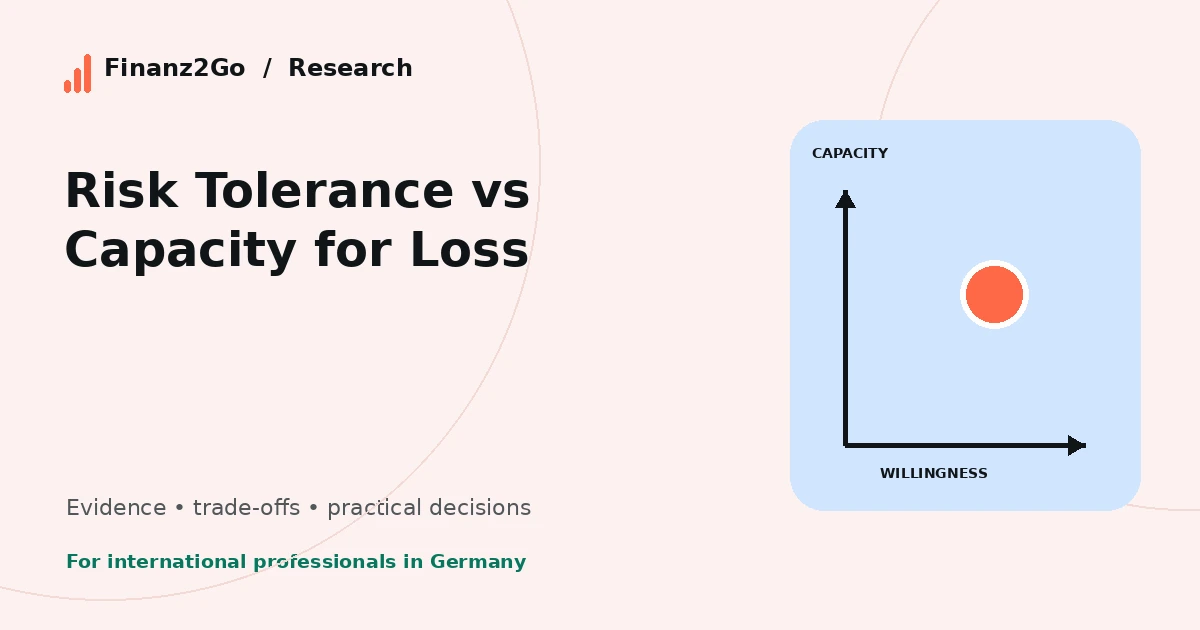
| Higher risk tolerance | Willing and financially able to take material risk, subject to goals, knowledge and product suitability | Emotionally willing but financially constrained; enthusiasm must not override liquidity and goal protection |
| Lower risk tolerance | Financially able but unlikely to tolerate the journey; a theoretically efficient risky portfolio may fail behaviourally | Both willingness and ability constrain risk; capital stability and goal design require close attention |
Willingness and ability can point in different directions
Risk tolerance and capacity for loss are separate constraints.
- 01
Willing, constrained
Enthusiasm must not override liquidity and goal protection.
- 02
Willing and able
Risk may be tolerable subject to goals and suitability.
- 03
Both constrained
Capital stability and goal design need attention.
- 04
Able, unwilling
A risky portfolio may fail behaviourally.
The matrix is diagnostic, not a direct map to an equity percentage or product. Knowledge, experience, horizon, liquidity, concentration and product complexity remain relevant.12
What shapes capacity for loss?
Liquidity and emergency reserves
Near-term essentials should not depend on a favourable market price. A separate emergency reserve can reduce forced-sale risk; the appropriate amount depends on job security, insurance, support and fixed commitments.
A listed asset may be sellable yet still realise a large loss when cash is needed. An illiquid product can add contractual restrictions or uncertain pricing. Capacity concerns both access and value.
Time horizon—and the timing of the goal
A long horizon can provide recovery time, but recovery is not guaranteed. The relevant horizon belongs to each goal, not to age alone: retirement may be 25 years away while a home deposit is needed in two. Capacity often declines as a fixed withdrawal date approaches.
Income stability and human capital
Stable earnings may support contributions after a downturn. Variable compensation, self-employment, sector concentration or a residence permit linked to employment can reduce resilience. High salary is not high capacity if commitments absorb most cash flow.
Goal importance and flexibility
A luxury purchase can usually be delayed or scaled down; basic retirement spending may not be flexible. Capacity is lower when a goal is essential, has a fixed date and lacks alternative funding. It is higher when timing, amount or funding source can adapt.
This suggests separating money by purpose before assigning risk. One household can rationally have different risk budgets for emergency funds, a five-year relocation reserve and a decades-long retirement portfolio.
Concentration, currency and country exposure
Capacity is about the household, not one account. Employer shares, property, pension rights and business ownership can create concentrated economic exposure outside the visible portfolio. For expats, assets and future spending may be in different currencies. Currency movements can increase or reduce the home-currency value available for a goal.
A move can also change account access, tax residence, reporting and the practical ability to maintain a product. Finanz2Go does not provide tax or legal advice; country-specific consequences require appropriately qualified specialists.
What shapes risk tolerance?
Loss framing
Percentages can conceal lived impact. “A 20% decline” should be translated into euros and consequences. On €200,000, it is €40,000. Would that change behaviour? Would it affect a goal, or merely feel uncomfortable? The distinction starts to reveal tolerance versus capacity.
Experience and recency
An investor who has only experienced rising markets may mistake untested confidence for tolerance. Someone who sold during a prior crash has valuable behavioural evidence, though circumstances may now differ. Recent performance can bias both optimism and fear.
Knowledge without bravado
Understanding fluctuations may improve preparedness, but expertise does not remove emotional or financial constraints. BaFin warns that shares can fall temporarily or permanently and may become worthless in an insolvency; diversification reduces some concentration risk but cannot prevent all loss.6
Risk required: the overlooked third dimension
An investor may be willing and able to take substantial risk but not need to do so. If a goal can be funded with a lower-risk plan under cautious assumptions, taking more risk is a choice rather than a requirement. Conversely, a plan may appear to require returns available only with a level of risk the investor cannot tolerate or afford.
Three constraints, one defensible risk level
Do not average willingness and ability into false comfort.
- 01
Risk tolerance
Can I stay through volatility and loss?
- 02
Capacity for loss
Can finances absorb loss without derailing important goals?
- 03
Risk required
How much risk appears necessary under stated assumptions?
That gap should not be solved by simply raising the risk score. Other levers include contributing more, spending less, delaying the goal, reducing the target, finding alternative income or accepting that the objective may not be feasible. Each has trade-offs.
Expected returns are uncertain, so “risk required” should be tested under several scenarios rather than one smooth forecast.
Scenario testing: make the distinction concrete
Consider a hypothetical investor with €150,000:
- €50,000 is earmarked for a home purchase in two years.
- €20,000 is an emergency reserve.
- €80,000 is intended for retirement in 25 years.
The investor says they are comfortable with a 30% stock-market fall. That statement concerns tolerance. It does not establish that all €150,000 has equal capacity. A 30% decline in the home deposit shortly before purchase could force a delay or smaller purchase. The retirement allocation may have greater capacity because its date is distant and contributions continue. The emergency reserve has a different function again.
If employment becomes uncertain and relocation may occur within six months, capacity can fall even if personality is unchanged. ESMA emphasises accurate, complete and current information and reassessment where the service includes periodic suitability review.3
Scenario tests should combine an immediate market fall, no quick recovery, income interruption, higher essential spending, an adverse currency move, an earlier goal date or illiquidity—and ask what the investor would do under stress.
The exercise is not a forecast. It reveals which assumptions are carrying the plan.
Counterarguments and difficult cases
“If the horizon is long, capacity is automatically high”
No. A long horizon helps only if the money can remain invested and the investor’s broader finances are resilient. Leverage, unstable income, concentrated assets, dependants or an earlier hidden liability can still make capacity low.
“A questionnaire gives an objective answer”
A well-designed questionnaire improves consistency, but it is an input rather than a truth machine. Wording, framing and current market mood affect responses. ESMA cautions against vague self-assessment and calls for objective criteria and checks for consistency between answers.3
“Knowledgeable investors can take more risk”
Knowledge affects whether a client understands a product. It does not create money after a loss. A sophisticated investor can have low capacity; a wealthy novice can lack the understanding needed for a complex product.
“More risk is necessary to beat inflation”
Inflation is a real threat to purchasing power, and assets with higher expected return may help over time. But taking unaffordable investment risk does not solve inflation risk safely. The plan must balance both and acknowledge that no asset allocation guarantees a positive real return.
Risks and boundaries
- A maximum tolerable loss is not a stop-loss guarantee. Markets can gap, liquidity can disappear and products can behave differently from historical examples.
- Diversification is not capital protection. Correlations can rise during stress, and broad portfolios can fall.
- Capacity is goal-specific and household-wide. Assessing one account in isolation can miss debts, pensions, property and dependants.
- Risk labels are not standardised truths. “Balanced” or “moderate” can describe different exposures across providers.
- Volatility is not the only risk. Permanent loss, inflation, credit default, illiquidity, currency mismatch and behavioural error matter.
- Suitability is not certainty. A suitable recommendation can still lose money.
- Tax and legal questions need specialists. Cross-border residence, pensions, inheritance, marital property and account access can materially affect decisions.
Practical checklist
- Define each goal, amount, date, priority and acceptable flexibility.
- Separate near-term liquidity and emergency needs from long-term capital.
- List income sources, essential spending, debts, dependants and guarantees.
- Inventory all assets—including property, employer shares, pensions and holdings abroad.
- Translate hypothetical losses into euros, not only percentages.
- Ask what would happen if loss coincided with unemployment, relocation or a family expense.
- Record both the loss you are willing to tolerate and the loss your plan can financially absorb.
- Identify the lower constraint; do not average willingness and capacity into false comfort.
- Test whether the goal actually requires the proposed level of risk.
- Check liquidity, concentration, currency and product-specific risks.
- Write down in advance what would trigger a review—not an impulsive sale.
- Reassess after marriage, separation, birth, inheritance, job change, large debt, property plans, retirement or relocation.
FAQ
Is risk tolerance the same as a risk profile?
Not necessarily. A profile may combine tolerance, capacity, objectives, knowledge and experience. Ask what the score measures.
Which should take priority: tolerance or capacity?
Neither should be ignored. In practice, the lower constraint often limits the amount of risk that is defensible. A plan must also consider the risk required for the goal and whether that goal is feasible.
Can capacity for loss be expressed as one percentage?
A percentage can be a useful scenario, but it may create false precision. Capacity depends on timing, liquidity, goals, income and other assets. “I can lose 20%” is incomplete unless the amount, period and consequence are clear.
How often should the assessment be updated?
Review after material life or financial changes and before major commitments. Where an investment service includes ongoing suitability review, the agreed frequency and triggers should be clear. A stale questionnaire should not override current facts.3
Can a portfolio be suitable and still suffer a large loss?
Yes. Suitability aligns a recommendation with the client information and product risks considered; it does not remove market risk or guarantee an outcome.
Does leaving Germany change risk capacity?
It can. Relocation may change currency needs, income, liquidity, provider access and tax or legal context. The effects are country- and person-specific and may require regulated advice plus qualified tax or legal advice.
Sources
- European Parliament and Council, Directive 2014/65/EU on markets in financial instruments (MiFID II), especially Article 25(2): https://eur-lex.europa.eu/legal-content/EN/TXT/?uri=CELEX%3A02014L0065-20240109
- European Commission, Consolidated Commission Delegated Regulation (EU) 2017/565, especially Article 54 on suitability: https://eur-lex.europa.eu/legal-content/EN/TXT/?uri=CELEX%3A02017R0565-20220802
- European Securities and Markets Authority (ESMA), Guidelines on certain aspects of the MiFID II suitability requirements (ESMA35-43-3172, 3 April 2023): https://www.esma.europa.eu/sites/default/files/2023-04/ESMA35-43-3172_Guidelines_on_certain_aspects_of_the_MiFID_II_suitability_requirements.pdf
- German Federal Financial Supervisory Authority (BaFin), Basic rules of investment: https://www.bafin.de/EN/verbraucherinnen-verbraucher/themen-finanzprodukte/geldanlage/einmaleins-der-geldanlage/einmaleins-der-geldanlage_node_en.html
- BaFin, Investment advice — What you need to know: https://www.bafin.de/EN/verbraucherinnen-verbraucher/themen-finanzprodukte/geldanlage/beratung-empfehlung/anlageberatung/anlageberatung_en.html
- BaFin, Shares: https://www.bafin.de/EN/verbraucherinnen-verbraucher/themen-finanzprodukte/geldanlage/wertpapiere/aktien/aktien_node_en.html
Author note: Fabian Beining is Founder & Research Author at Finanz2Go. This role description is not a statement that he personally holds a §34f GewO registration. Regulated advice is provided through the applicable registered advisory structure, whose current particulars are disclosed before regulated advice begins.
Update policy: Review after material changes to EU or German suitability rules or ESMA guidance; otherwise review at least annually. Revisit examples if the site’s service scope or audience changes.
Start with a short conversation
Turn research into better questions
An introductory call can clarify scope and likely next steps. Personal advice requires complete fact-finding and the appropriate regulated advisory process.
Book an introductory call ↗A fit conversation — not personal investment advice.