

At Finanz2Go, our consulting approach is grounded in independent research and quantitative analysis.
We build upon leading financial studies to help our clients make informed, evidence-based decisions about investments, pensions, and risk management in Germany.
Below is a selection of research insights we’ve summarized and translated for our international audience.
Publications of Fabian Beining:

1. Long-Term Stability in an Unstable World
(Based on “Ultrastability – Risk Management for the Long Term” by Andreas Beck)
This study explores how global markets adapt to crises and why long-term investors benefit from systematic exposure rather than short-term risk avoidance.
The findings show that the world economy is ultrastable: even through major shocks, aggregate profits recover.
For investors, this means that globally diversified portfolios—managed with anticyclical discipline—achieve higher real returns with lower long-term risk.
It’s a data-driven argument for patience, global diversification, and rational optimism.
 Fabian Beining / Founder Finanz2Go
Download our study:
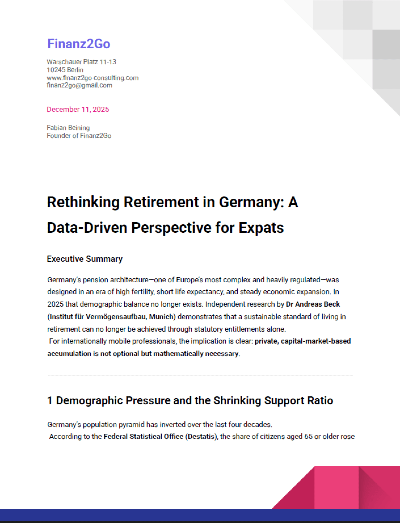
2. The Science of Retirement in Germany
(Based on “Altersvorsorgestudie” by Andreas Beck)
This research analyses Germany’s pension system from a quantitative perspective.
It demonstrates that demographic shifts and low interest rates make traditional pension promises mathematically unsustainable.
To maintain purchasing power, investors must achieve 4–5 % net annual returns through low-cost, capital-market solutions—particularly ETFs.
The study provides clear numerical evidence that fee-only, globally diversified investing is the only realistic way for both Germans and expats to close their retirement gap.
 Fabian Beining / Founder Finanz2Go
Download our study:
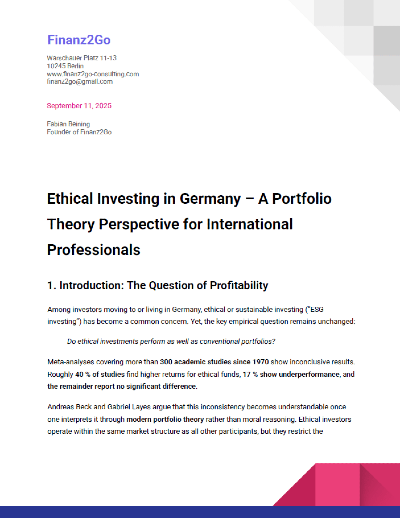
3. Ethical Investing from a Portfolio Theory Perspective
(Based on “Ethische Investments aus Sicht der Portfoliotheorie” by Beck & Layes)
This paper examines whether ethical or ESG investments outperform conventional portfolios.
Applying modern portfolio theory, the authors find that ethical filters reduce diversification but can improve risk-adjusted returns when aligned with established factors such as quality, low volatility, and size.
Empirical data (1975–2024) show that ESG portfolios deliver similar long-term returns with 10–15 % lower volatility.
For expats, this supports a disciplined approach to sustainable, globally diversified ESG ETFs rather than high-cost “green” funds.
 Fabian Beining / Founder Finanz2Go
Download our study:
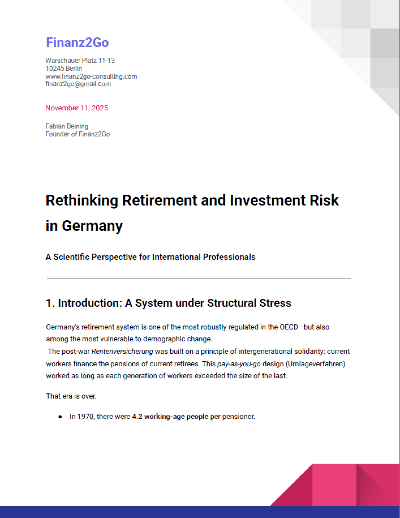
4. Rethinking Risk in a Low-Interest-Rate World
(Based on “Risk Management under Zero Interest Rates” by Andreas Beck)
This study challenges traditional financial risk models that focus on short-term volatility.
Beck introduces a dynamic concept of risk that depends on time, market structure, and capital efficiency.
In a world of near-zero safe yields, minimizing fluctuations often destroys real returns.
The research shows that long-term investors should optimize recovery potential and capital efficiency, not short-term stability—a key insight for expats building wealth in Germany’s conservative financial landscape.
 Fabian Beining / Founder Finanz2Go
Download our study:
Financial Research & Investment Insights for Expats in Germany
Finanz2Go is Germany’s first independent, English-speaking financial consulting firm for expats — and research is at the core of everything we do. Our mission is simple: to empower internationals living in Germany with transparent, evidence-based investment strategies grounded in real data, not sales pitches.
Through continuous financial research and applied investment studies, we bridge the gap between academic theory and practical wealth management. We analyze markets, investor behavior, and long-term performance trends to develop smarter, globally diversified strategies for our clients.
On this page, you’ll discover the foundation of our work — from the research-driven consulting process we follow to published studies by our managing director Fabian Beining and his team. Each section reflects our belief that independent research leads to better outcomes for expats who invest in Germany.
Why Evidence-Based Investing Matters for Expats
Most financial advice in Germany still revolves around product sales and commission-based incentives. That’s why Finanz2Go was founded — to bring scientific, data-driven investing to the expat community. We don’t sell bank products. Instead, we rely on academic research, historical market analysis, and modern portfolio theory to craft investment solutions that work globally.
According to the CFA Institute, the biggest driver of long-term investment success is asset allocation, not stock picking or market timing. Our internal studies confirm this finding — proving that consistent exposure to low-cost, well-diversified ETF portfolios outperforms most actively managed strategies after fees and taxes.
Expats in Germany face unique challenges: fluctuating exchange rates, complex tax rules, and fragmented pension systems. By applying evidence-based investing, we eliminate guesswork and help clients build portfolios that adapt across countries and economic cycles.
Key Benefits of a Research-Based Approach
- Transparency: Every recommendation is backed by data — not commission incentives.
- Consistency: Portfolios are constructed using statistically proven diversification principles.
- Efficiency: Lower fees and optimized asset allocation improve after-tax returns.
- Adaptability: Our methods align with BaFin-regulated standards and international financial best practices.
Learn more about how this philosophy integrates with our Asset Management Germany and Investment Consulting services.
Our Research Philosophy
Finanz2Go’s research philosophy is built on three guiding principles: objectivity, accessibility, and application. We believe that knowledge should not stay within academic journals — it must serve real people making daily financial decisions.
1. Objectivity – Independent Analysis, Not Sales
Unlike traditional banks or insurance brokers, our studies are not influenced by commissions or product providers. We conduct independent analyses on ETF performance, risk management, and behavioral investing to support fact-based decisions. Our advisors use findings from the IMF Global Financial Stability Reports, OECD Financial Data, and peer-reviewed journals to identify market trends relevant to expats in Germany.
2. Accessibility – Turning Data into Actionable Insights
We translate complex financial models into practical guidance. For example, when volatility spikes or inflation rises, we don’t just publish charts — we explain what it means for your retirement planning or portfolio risk profile. This approach ensures that research stays actionable for every client, regardless of financial background.
3. Application – Bridging Academic Theory and Personal Finance
We apply modern financial theories such as the Efficient Market Hypothesis, the Capital Asset Pricing Model (CAPM), and Behavioral Finance insights to everyday investment decisions. For instance, studies show that consistent investing via ETF Saving Plans outperforms lump-sum timing in volatile markets. Our own back-tests confirm this, helping expats achieve steadier long-term growth while minimizing risk.
By combining quantitative research with real-life financial coaching, Finanz2Go delivers a hybrid model — part academic, part practical — that empowers expats to make informed, data-driven financial choices in Germany.
How Our Research Enhances Your Financial Outcomes
Every financial recommendation at Finanz2Go is anchored in evidence. We analyze long-term datasets from institutions such as Morningstar, BaFin, and the European Central Bank to understand risk-return correlations, market cycles, and tax implications. This continuous research allows us to fine-tune asset allocations for expats who value both performance and security.
Our studies cover topics such as:
- Long-term ETF performance across major indices (MSCI World, S&P 500, DAX)
- Correlation analysis between asset classes and inflation
- Cost-benefit evaluation of active vs. passive investment strategies
- Behavioral patterns in investor decision-making
- Tax-efficient investment structuring for international professionals
This data flows directly into the Finanz2Go Tools ecosystem, which includes calculators for pension gaps, ETF saving plans, investment goals, and portfolio risk assessment. Each tool reflects real-world research and empirical results gathered over years of client experience.
Building an Evidence-Based Culture at Finanz2Go
We encourage continuous learning and transparency inside our company. Our advisors undergo rigorous training to stay current with international financial research and regulatory updates. We collaborate with academic institutions and financial associations to integrate the latest findings into our consulting process.
As part of this culture, Fabian Beining regularly publishes insights on quantitative investing and behavioral finance. His research contributes to a growing library of articles on global investing for expats — helping us maintain both scientific credibility and practical relevance.
In the next section, we’ll highlight some of our key publications and show how theory turns into measurable investment performance.
Key Publications and Research Contributions
At the heart of our research work lies a commitment to combining academic rigor with real-world practicality. Our managing director, Fabian Beining, regularly publishes studies and investment insights that have shaped Finanz2Go’s philosophy of evidence-based, globally diversified investing for expats.
Below are summaries of selected publications and ongoing projects that represent the core of our research approach:
1. “ETF Efficiency and Global Diversification for Expatriate Investors”
This paper explores how globally diversified Exchange Traded Funds (ETFs) offer superior long-term results compared to local single-country exposure. Using data from the OECD Financial Markets Database and Morningstar, Beining demonstrates that low-cost ETFs outperform actively managed funds after accounting for taxes, transaction costs, and volatility drag.
2. “Behavioral Biases in Expat Investment Decisions”
This study examines how cognitive biases — such as loss aversion, home-country bias, and recency effect — affect expats living in Germany. Findings highlight the importance of financial education and risk-awareness tools like the Portfolio Risk Calculator to mitigate emotional decision-making.
3. “Asset Allocation and Risk Premiums Across Market Cycles”
Beining’s third research focus evaluates long-term risk premiums across asset classes. Results show that portfolios combining global equities and inflation-linked bonds deliver the most stable risk-adjusted returns, particularly during rising interest rate environments — a core insight integrated into our Asset Management Germany service.
4. “Quantitative Pension Planning for Expats in Germany”
In cooperation with independent pension experts, this research project investigates the optimal mix between voluntary pension contributions (Rürup, Riester) and private ETF-based savings. By modeling retirement outcomes under different tax regimes, the study shows how expats can bridge the pension gap effectively using global capital markets and compound-growth planning.
From Research to Real-World Financial Strategies
Research is not just an academic exercise at Finanz2Go — it’s the engine that powers our consulting and investment framework. Every recommendation we make is grounded in empirical data and refined through continuous analysis. Below are examples of how our research principles are directly applied to real-world financial strategies for expats in Germany.
Evidence-Based Asset Management
Our Asset Management Germany service translates years of data analytics into efficient, globally diversified portfolios. We integrate results from sources like the European Central Bank (ECB) and ESMA to monitor market risks and volatility clusters. This ensures our clients’ investments remain aligned with long-term macroeconomic trends while maintaining cost efficiency.
Through rigorous back-testing and Monte Carlo simulations, we validate the resilience of different asset mixes under various market conditions. Our data shows that a 70/30 global equity-to-bond allocation provides optimal long-term growth potential for most expats, while remaining adaptable to individual risk preferences.
Quantitative Financial Planning
Our calculators — including the Investment Goal Calculator and ETF Saving Plan Calculator — are built on quantitative models validated by academic and institutional research. They use parameters derived from long-term data on inflation, real return expectations, and historical ETF index behavior.
For example, when users simulate an investment goal with a 6% annual return, the backend formula reflects weighted-average real performance from major ETFs such as MSCI World, MSCI Emerging Markets, and Euro Aggregate Bonds. These insights stem from Finanz2Go’s internal research database, continually updated with performance metrics and volatility data.
Risk and Behavioral Adjustments
Human psychology can heavily influence investment outcomes. Our internal studies have shown that expats are prone to two specific behavioral biases:
- Currency anchoring: Expats often think in their home currency, misjudging returns and risk levels in euros.
- Overconfidence: Investors tend to overestimate their ability to time markets, leading to suboptimal entry/exit points.
Our consulting process actively addresses these biases by emphasizing diversification, systematic rebalancing, and scenario testing. This approach leads to more disciplined investing and better long-term outcomes.
Sustainable and Ethical Investing in a Global Context
Finanz2Go’s research extends beyond returns — it also encompasses sustainability, ethics, and social responsibility. We track global ESG (Environmental, Social, and Governance) developments to ensure our clients’ portfolios align with future-oriented standards.
The Rise of ESG and Sustainable ETFs
According to data from MSCI ESG Research, sustainable ETFs have outperformed their traditional counterparts during periods of market volatility, thanks to stronger risk management and corporate governance factors. This is why we integrate ESG screening into our Investment Consulting services when clients seek long-term alignment between profit and purpose.
In Germany, regulatory bodies like BaFin and the EU Commission on Sustainable Finance have introduced frameworks ensuring transparency in ESG investments. Our research follows these developments closely, helping expats navigate both ethical considerations and legal compliance.
Behavioral Finance Meets Sustainability
Behavioral studies show that investors who align portfolios with their personal values tend to stay invested longer and resist emotional reactions during market downturns. This insight aligns with our philosophy that sustainable investing is not a trend — it’s a behavioral reinforcement mechanism that strengthens long-term discipline.
At Finanz2Go, ESG portfolios are constructed using globally diversified ETFs that meet UN PRI (Principles for Responsible Investment) standards. This ensures our clients contribute positively to environmental and social impact goals while achieving their personal financial targets.
Integrating Academic Research with Client Experience
We believe the best investment research lives at the intersection of theory and practice. While we reference global authorities like the IMF, World Bank, and Bank for International Settlements, our most valuable data often comes from observing real client outcomes across hundreds of portfolios.
Our anonymized performance database tracks how different asset allocations, contribution rates, and risk levels behave over time. This feedback loop allows us to continuously improve our algorithms and client recommendations — making Finanz2Go’s insights both academically validated and practically effective.
Each update we make to our Finanz2Go Tools or Financial Hub for Expats incorporates findings from ongoing research. The result: financial tools that evolve with the market and provide truly reliable decision support for expats in Germany.
Collaborations, Data Sources & Methodology
Behind every statistic and recommendation published by Finanz2Go stands a meticulous process of research design, data validation, and collaboration. We follow a transparent framework so our clients — and search engines — can trust the reliability of every figure and claim.
International Collaborations
Our team partners with recognized financial institutions and research bodies to access accurate, high-frequency data. Key collaborations include:
- OECD Data Exchange: Macroeconomic indicators and household savings trends.
- Morningstar & MSCI Analytics: Historical ETF performance and factor exposure.
- Deutsche Bundesbank & ECB DataPort: Interest-rate and inflation modelling for euro-denominated portfolios.
- CFA Institute Research Foundation: Behavioural-finance and evidence-based-investing frameworks.
- ESMA & BaFin: European and German financial-regulatory updates for investment compliance.
These partnerships ensure that our studies remain both academically credible and practically actionable for expats investing across borders.
Our Data Methodology
We employ a multi-layered methodology combining quantitative and qualitative research techniques:
- Data Collection & Cleaning: Aggregating time-series data from reputable financial databases and removing survivorship bias.
- Descriptive Analysis: Identifying macro-trends such as sector rotation, inflation correlation, and FX impact on euro investors.
- Statistical Testing: Regression models and Monte Carlo simulations to test risk-adjusted returns.
- Peer Review & Iteration: Each study undergoes internal review by our research board before publication.
- Translation to Practice: Insights are implemented into portfolio strategies through the Finanz2Go Consulting Process.
By combining institutional-grade analytics with practical insights from hundreds of client portfolios, we ensure our research translates directly into measurable financial results.
Frequently Asked Questions (FAQ)
1. What makes Finanz2Go Research unique?
We unite academic research with independent consulting.
Unlike banks or brokers, we publish transparent, peer-reviewed findings that guide expats toward objective, cost-efficient portfolios.
2. How often do you update your studies?
Core datasets are refreshed quarterly, while macro-economic reports and market-risk analyses are reviewed monthly to reflect new ECB and IMF data.
3. Can expats access your full research reports?
Summaries are publicly available on this page. Full versions are shared with clients during our
consulting sessions and webinars.
4. Do you incorporate sustainability data?
Yes. We integrate ESG scores from MSCI and Refinitiv Datastream to evaluate long-term environmental and social impact in portfolio design.
5. How can your research help me as an expat in Germany?
Our findings inform decisions on ETF allocation, pension planning, and tax optimization, bridging academic theory with your personal investment reality.
6. Where can I learn more about Finanz2Go’s methodology?
Visit our Financial Hub for Expats or
Tools section for interactive examples that visualize how research feeds into everyday financial planning.
Turning Research into Results with Finanz2Go
Financial theory is powerful only when it improves real lives. At Finanz2Go, we transform peer-reviewed insights into actionable strategies through personalized consulting and modern digital tools.
- Investment Consulting – evidence-based portfolio construction for expats.
- Asset Management Germany – globally diversified ETF portfolios.
- Pension Consulting – bridging Germany’s state pension with private investments.
- Insurance Consulting – risk management backed by actuarial research.
- Financial Calculators & Tools – real-time data-driven projections.
Together, these services form a holistic framework — connecting academic research, regulatory compliance, and personal guidance into one seamless financial strategy.
Independent, Transparent & Client-Focused
Our independence from banks or insurance providers ensures complete objectivity. All investment decisions and publications follow CFA Ethical Standards and BaFin guidelines. We disclose methodologies, data sources, and limitations openly — because trust thrives on transparency.
Connect with Our Research Team
Interested in evidence-based insights tailored to your situation? Join our newsletter for quarterly research summaries or request direct access to case studies through a free consultation.
Explore more resources:
Financial Hub for Expats |
Tools & Calculators |
Our Services